Articles 'The' 'A' and 'An'


Articles are pre-modifiers normally used before noun. We have two types of articles: the definite article and the indefinite article.

Definite Articles (The)
A definite article is used with specific names of people, animals, places or things. It is used with nouns that we are familiar with. That is, the noun should be what we were talking about previously. For example:
  • I saw a boy yesterday; the boy gave me some money.
It is called the definite article because it is used specifically.

Observe this dialogue!
First speaker: The boy came here
Second speaker: Oh! You mean John?
First speaker: Yes!

In the dialogue above, you will observe that 'John' being the subject matter, is not new in the conversation.

Article 'The' is used in the following areas:

With Names of Countries
Examples:
i. The Federal Republic of Nigeria
ii. The United State in America
iii. The People's Republic of China

With Geographical Location
Examples:
i. The Pacific Ocean
ii. The River Niger
iii. The Red Sea
iv. The Sahara desert
v. The Atlantic Ocean

With Family Names
Examples:
i. The Ayanwoles
ii. The Babalolas
iii. The Dangotes

Note: When article 'the' is used with family names, 's' is added to that family name as seen in the examples above.

With Names of Popular Figures
Examples:
i. The Soyinka of Nigeria
ii. The Miss Sanda of the United Africa Organization

Note: Article 'the' is used with names of popular figures when we want to differentiate between them and other people bearing the same name as seen in the examples below.

i. I saw Mr Buhari, not the Buhari of Nigeria.
ii. I saw Mr Oyetola, not the Oyetola of Osun State.

With names of Associations, Clubs and Unions
Examples:
i. The Movement for the Emancipation of the Niger Delta
ii. The Ife Descendants Association
iii. The Lions Club

With Designations/Titles
Examples:
i. The Inspector General of Police
ii. The Chairman of NURTW

With Musical Instruments
Examples:
i. He is good with the piano
ii. She enjoys playing the saxophone

But not that article 'the' will not be used with modern musical instruments. For instance, you do not say:

He enjoys the jazz music
She plays the bass in our band
But:
He enjoys jazz music
She plays bass in our band

The Indefinite Articles
There are two indefinite articles: Articles 'a' and 'an'. The indefinite articles are used with nouns requiring unspecific information. That is, they are not specific. They are used when we are not referring to any particular person or things. For example:

i. A man came here.
ii. An orange was stolen.

The difference between article 'a' and article 'an' is that, article 'a' is used with nouns that begins with a consonant (sound) while article 'an' is used with nouns that begins with a vowel (sound).

For example:
An orange, an egg
A car, a table

Note: Articles 'a' and 'an' are used only with singular countable nouns.

Examples:
1. She came from a good and an honest family.
2. The boy is a European.
3. We spend an hour to this time.
4. John is quiet an honest man.
5. The man is planning to build a house.
6. The chairman slept over in a hotel.
7. We went to Oyo state to experience a historical event.
8. What I see is merely a utopia.
9. I saw the king riding on a horse yesterday.

Moving on to the next article: Subjunctive (Real and Unreal Future)
Grammatical Names And Functions In English


Clauses and Phrases
Phrases and clauses are two common grammatical names in English. Whereas a phrase is defined as a word or group of words without a finite verb which has meaning and has a particular linguistic function, a clause is defined as a word or group of words with a finite verb (finite clauses) or with a non-finite verb (non-finite clause), may make a complete sense (independent clauses) or may not make a complete sense (dependent causes) and has a particular linguistic function.

A clause is different from a phrase typically by the absence of a verb in a phrase. In Modern Grammar, a phrase is also know as a Group. There are five common types of phrases in English and they include Noun Phrases, Adjectival Phrases, Verbal Phrases, Adverbial Phrases and Prepositional Phrases. Clauses on the other hand include: Noun Clauses, Adjectival Clauses and Adverbial Clauses.

Noun Phrases
A Noun phrase is also known as a Nominal Phrases and it is headed by a noun or a pronoun. To identity a noun phrase from a sentence we ask the questions: 'what', 'who', 'whom' or 'where' in place of the phrase. If the question is logical and the phrase can directly answer the question, then it is a noun phrase.

A noun phrase can be a word e.g. man, boy, house, he, she, they, etc. These are simple noun phrases. A noun phrase can also be complex. Complex noun phrases have some words coming before the noun Head represented by "H". The words coming before the noun head are known as Modifiers represented by "M".

Examples:
i. The (M) man (H)
ii. The (M) two (M) houses (H)

A noun phrase can also have some words coming after the noun head, telling you more about the noun (head). When this is so, such words are known as qualifiers represented by "Q".

Examples:
i. The (M) house (H) in the street (Q)
ii. The (M) man (H) behind the tree (Q)
iii. Stars (H) above (Q)

Grammatical Functions of Noun Phrases

Noun phrases function as nouns in a sentence and these grammatical functions are discussed below:

As Subject (S) of the Verb of a Sentence

Examples:
1. The man behind my back (S) is (P) a thief (C)

Let us use our question method to test whether the grammatical name is really a noun!

Question: "Who" is a thief?
Answer: The man behind my back

2. Stars above (S) are much (P)

Question: "What" are much?
Answer: Stars above

As Object (O) of the Verb of a Sentence
A noun phrase can also function as a object of a sentence.

Examples:
1. Mary (S) saw (P) the man in a white shirt (O).

There are two types of object: direct (Dir) and indirect object (Ind). Let us consider the examples below:

2. John (S) gave (P) him (Ind) a book (Dir)

Note that the ' giving object' is the indirect object and it normally comes first while the one 'receiving object' is the direct object and normally comes last.

As Complement (C) of a Sentence
A noun phrase can also function as the complement of a sentence. The complement of a sentence is that part of a sentence which tells us more about either the subject or object of a sentence. They are objects referring to the subject or object.

A noun phrase can function as the object or subject complement of a sentence

  • Noun phrases functioning as the subject complement e.g.

3. John (S) is (P) the new Vice President (C)
4. Peter (S) is (P) the chairman of his father's company (C)

  • Noun phrases functioning as the object complement e.g.

5. John (S) made (P) his father (O) a proud man (C)

As Apposition/Appositive in a Sentence
An Appositive is that part of a sentence that tells more about the subject or object but unlike the complement, comes immediately after the subject or object. Appositions are also referred to as two nouns in same subject or object position referring to each other.

Examples:
1. Mohammed Buhari (S), the President of Nigeria (A) is (P) my uncle (C)
2. I (S) saw (P) Frank Okotie (O), the pastor of my church (A)

As Object of Preposition
In this function, the noun phrase will come after a preposition.

Examples:
1. I saw her behind a slim man.

Question: I saw her behind "where"?
Answer: a slim man
Where "behind" is the preposition.

2. The girl fainted during the class.

Question: The girl fainted during "When"?
Answer: the class
Where "during " is the preposition.

We continue in the next article.
Part of Speech (Part 1): Pronouns in English


We define pronouns as words we use instead of nouns to avoid unnecessary repetition. We have different types of pronouns and they include: personal pronouns, reflective pronouns, reciprocal pronouns, possessive pronouns, interrogative pronouns, demonstrative pronouns, etc.

Note that all the pronouns mentioned above are Definite pronouns. We also have Indefinite pronouns. They are pronouns that do not specifically and exactly point out the nouns they represent. Examples include: somebody, anybody, someone, nobody, everybody, everything, everyone, something, none, etc.

The Definite Pronouns

Personal Pronouns
Personal Pronouns are directly used to refer to individuals. We have three types of personal pronouns, they include:

- First Person Pronouns
- Second Person Pronouns
- Third Person Pronouns

There are two major cases associated with these personal pronouns. They include:
i. The Subjective Case
ii. The Objective Case

When we say subjective case, we mean the first or initial position of a sentence before the verb. It is also referred to as a subject position. The objective case on the other hand, is the position after the verb of the sentence. It is the position occupied by the receiver of the action. Note that once the pronoun crosses the verb, it becomes an object pronoun, so you must not make the mistake of using a subject pronoun in an object pronoun.

Note these examples!
i. Baba and he (not him) participated in the tournament. It cannot be 'him'. It has not crossed the verb - 'participated'.

ii. Those men helped Dupe and me. (Not I, myself, or we) because it has not crossed the verb 'helped'.

First Person Pronouns: I (subject) / me (object) - first person singular and we (subject) / us (object) first plural.

When we say first person pronoun, we are referring to the person who is speaking. The first person singular pronoun 'I' may be singular but it takes a plural verb.

Examples:
i. I see John every day. (Not sees)
ii. He greets me.
iii. We slapped the man.
iv. He insulted us.

Second Person Pronoun
The only second person pronoun we have is 'you'. The object case is also 'you'.

Examples:
i. You are lazy (subject position)
ii. John slapped you? (object case)

Third Person Pronouns
He, She, It (singular subjective case)
Him, her, it (singular objective case)
They (plural subjective case)
Them (plural objective case).

Rules for using the subjective and objective case

Rule one
When a third or second person, be it noun or pronoun, is used with the pronoun 'I/me', the second or third person should come first before 'I'. This is called rule of selflessness.

Examples:
i. Efe and I should eat the food (Not I and Efe)
ii. You and I have been selected for the game. (Not I and you)
iii. The man gave John and me some money (Not me and John)

Rule two
Please note that when a prepositions such as amongst and between are used, the objective case of a personal pronoun should be used.

Examples:
i. Share this money amongst John, them and me.
ii. The profit of the business was apportioned between her and him.

Rule three
When comparing, we should use the subject case. Actually, in this instance, there is an ellipsis of a verb coming at the ending of the sentence.

Examples:
i. We seems stronger than they. (Stronger than they are)
ii. My sister cooks better than I. (Better than I cook)

Rule four
When a question is asked with a verb of performance, we reply with a subject pronoun but when the verb is not performed verb, we reply with an object pronoun.

Examples:
i. Speaker A: Who is knocking at the door?
    Speaker B: It is I.

The reply is in subject case 'I' because the question is asked with a performance verb 'is knocking'

ii. Speaker A: Who is at the door?
    Speaker B: It is me.

The reply is in objective case 'me' because the question is not carrying a performance verb. No action is actively performed. In Physics, they would say "there is zero work done"

iii. Speaker A: Who ate the food?
    Speaker B: It is I. (There is work done)

Sometimes, it may not be the form of a question, but just referring to a person.
iv. The Ibos like Ojukwu, it was he (not him) who fought for their race.

Rule five
When citing sentence, the introducer we use determines the case. If the introducer is 'like', note that the pronoun will be in the objective case but if the introducer is 'such as' the pronoun will be in the subjective case.

Examples:
i. I am used to ruffians like him (Not he)
ii. Bad leaders such as they (not them) should be punished forthwith.
iii. Lazy boys such as he (not him) should suffer.
iv. Students like them (not they) should be encouraged.

We will treat more on the other types of pronouns later on
Subjunctive (Real and Unreal Future)


When using certain phrases to express certain actions we should be mindful of the verbs that follow. When expressing the future we use present tense to express what will most likely occur, this is known as Real Future. And when we use past tense, it implies that the action will most likely NOT occur. This is known as Unreal Future. Note that there are always two clauses in this types of sentences and the verb in the first clause must agree with the verb in the second clause in terms of their tenses. That is, if a verb in the first clause is present tense, the verb in second clause will be present tense (vice versa). Examples:

1. If he arrived late, everyone would blame him.
2. If I go to the church tonight, I will return late.
3. If I went to the church tonight, I would return late.
4. If things were going as planned, I would have been in London next week.

Note that it is not all cases that there are only clauses in the sentences; there may be a phrase and a clause e.g.

i. By the end of next month, I will have finished my exam. (The speaker is certain of this therefore, it is a real future).
ii. By the end of next month, I would have finished my exam. (The speaker is not sure therefore, it is unreal future).

In subjunctives, there are also certain phrases that are significant in choosing the verb of a sentence, they include: It's time, it's high time, it's about time, etc. When they are used, the verb should be in past tense.

Examples:
i. It's high time I left home. (Not leave)
ii. It's about time we saw him. (Not see)
iii. It's time we ate the meal. (Not eat)

The general rule in changing verbs from one tense to another is - if phrases such as: if, as if, I wish, I'd rather, suppose/supposing are used in expressing unreal situation. Note that:

i. Present actions will take past tense verbs
ii. Actions referring to the future will take past tense verbs
iii. Actions in the past will take past perfect verbs

Note that the past perfect is indicated by auxiliary verb 'had' in front of the main verb. Examples:

1. If I were you I would disappear. (Present action taking past tense verb)
2. If I were you, I would never visit him again. (Present action taking past tense verb)
3. I wish I could fly. (Present action taking past tense verb)
4. I would rather you saw him next week. (Future action taking past tense verb)
5. You talk as if you were a parrot. (Present action taking past tense verb)
6. I wish we had seen last month. (The action is in the past therefore the verb is in the past perfect form)
7. I'd rather we visited her without further delay. (Here the action is in the present therefore the verb will be past)
8. I'd rather we had visited her yesterday. (Here the action is in the past therefore the verb will be past perfect).
Simple equations on Surds

Numbers such as 6, 0.37, 0.6 can be express as exact fractions or ratio: 6/1, 37/100, 2/3. these are called rational numbers.
 
Numbers which cannot be written as ratio are called irrational or non-rational numbers. pie is an example of an irrational number.
 
pie= 3.141592....
 
 Methods of Manipulating Surd
1. Simplification of Surd
2. Addition & Subtraction of Surd
3. Multiplication & Division of Surd
4. Conjugate of a Surd

General Rules for Solving Surd
1. Figures with figures and roots with roots.
2. When multiplying roots of similar values, you remove the roots and take only one of the values.
1. Simplification of Surd
Examples;
Simplify the following surd;


Solution


Split 


by searching for factors of 50 whereby at least one of them must be a perfect square.

Following this rule, the factors should be either 5 & 10 or 25 & 2 or 50 & 1 but 25 & 2 should be the most appropriate factor here because you can at least find the square root of 25 which makes it a perfect square.


Solution

Factors of 32 will be 16 & 2;


Note that at least one of the factors must be a perfect square.


Solution


The Geometry of Triangles

Definitions and formulas for the area of a triangle, the sum of the angles of a triangle, the Pythagorean theorem, Pythagorean triples and special triangles (the 30-60-90 triangle and the 45-45-90 triangle)
Just scroll down or click on what you want and I'll scroll down for you!
 

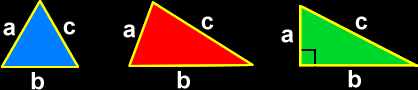
examples of triangles area of a triangle sum of the angles
of a triangle
The Pythagorean Theorem special Pythagorean
triples
special triangles
45-45-90 & 36-60-90

Examples of triangles:
triangle graphic
red line
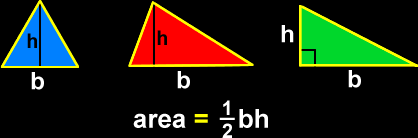
The area of a triangle:
triangle graphic
red line
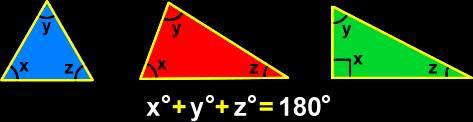
The sum of the angles of a triangle:
triangle graphic
Always, always, ALWAYS!
red line
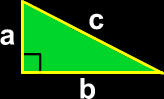
The Pythagorean Theorem:
triangle graphic
This formula is for right triangles only!
The sides, a and b, of a right triangle are called the legs, and the side that is opposite to the right (90 degree) angle, c, is called the hypotenuse.  This formula will help you find the length of either a, b or c, if you are given the lengths of the other two.

triangle graphic
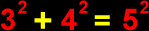
Some special Pythagorean numbers:
These are called Pythagorean triples. 
triangle graphic                  triangle graphic
 The reason that they are so special is that they are whole numbers -- none of those weird decimals, fractions or radicals!
red line

Special Triangles:
triangle graphic
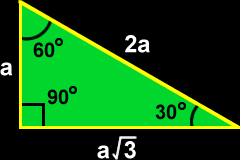
The 30-60-90 Triangle:
If you have one side, you can use these formulas (and maybe a little algebra) to get the others.
red line
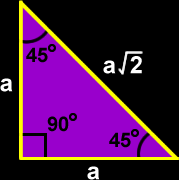
triangle graphicThe 45-45-90 Triangle:
If you have one side, you can use these formulas (and maybe a little algebra) to get the others.
 Solving Trigonometry with examples

There are two new vocabulary terms that may appear in application problems.
 

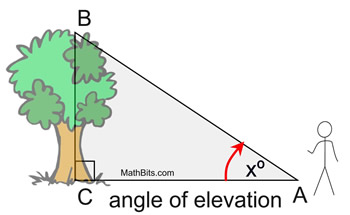
Angle of Elevation:
elevation1
In this diagram, xº marks the
angle of elevation of the top of the tree
as seen from a point on the ground.
The angle of elevation is always measured from the ground up. It is an upward angle from a horizontal line. It is always inside the triangle.

You can think of the angle of elevation in relation to the movement of your eyes. You are looking straight ahead and you must raise (elevate) your eyes to see the top of a tree.

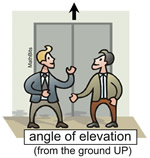
When trying to remember the meaning of an
angle of elevation think of an elevator that only goes up!
elevation2
Angle of Depression:
elevation4
In this diagram, xº marks the
angle of depression of the boat at sea
from the top of the lighthouse.
The angle of depression is always OUTSIDE the triangle. It is never inside the triangle. It is a downward angle from a horizontal line.
You can think of the angle of depression in relation to the movement of your eyes. You are standing at the top of the lighthouse and you are looking straight ahead. You must lower (depress) your eyes to see the boat in the water.
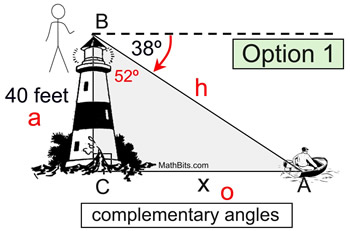
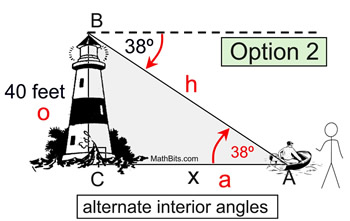
Notice how the horizontal line in the angle of depression diagram is PARALLEL to the ground level. The fact that horizontal lines are always parallel guarantees that the alternate interior angles are equal in measure. In the diagram, the angle marked xº is equal in measure to
mBAC. Simply stated, this means that ...
the angle of elevation = the angle of depression
option1
When solving a problem with an angle of depression you need to find the measure of an angle INSIDE the triangle. There are two options:
Option 1: find the angle inside the triangle that is adjacent (next door) to the angle of depression. This adjacent angle will always be the complement of the angle of depression, since the horizontal line and the vertical line are perpendicular (90º). In the diagram at the left, the adjacent angle is 52º.
elevaton8
Option2
Option 2: utilize the fact that the angle of depression = the angle of elevation and label ∠BAC as 38º inside the triangle.
elevation9
Notice that both options, the answer is the same.

dividerdash

Let's see how to put these skills to work in word problems.
ex1
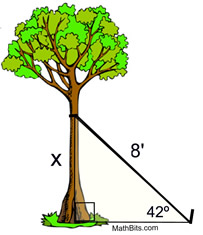
A nursery plants a new tree and attaches a guy wire to help support the tree while its roots take hold. An eight foot wire is attached to the tree and to a stake in the ground. From the stake in the ground the angle of elevation of the connection with the tree is 42º. Find to the nearest tenth of a foot, the height of the connection point on the tree.
elevEx2
SOLUTION:
• A "guy" wire is a support wire used to hold a newly planted tree in place, preventing it from bending or up-rooting during high winds.
• The "angle of elevation" is from the ground up.
• It is assumed that the tree is vertical, making it perpendicular with the ground.
• This problem deals with "opposite" and "hypotenuse" making it a sine problem.
elevex2m


ex2
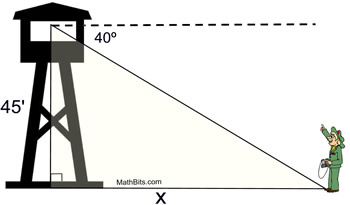
From the top of a fire tower, a forest ranger sees his partner on the ground at an angle of depression of 40º. If the tower is 45 feet in height, how far is the partner from the base of the tower, to the nearest tenth of a foot?

elevex3
SOLUTION:
• Remember that the "angle of depression" is from a horizontal line of sight downward.
• It is assumed that the tower is vertical, making it perpendicular with the ground.
• This solution will use alternate interior angles from the parallel horizontal lines, so place 40º inside the triangle by the partner (bottom right).
• This solution deals with "opposite" and "adjacent" making it a tangent problem.
elevex3m

ex3
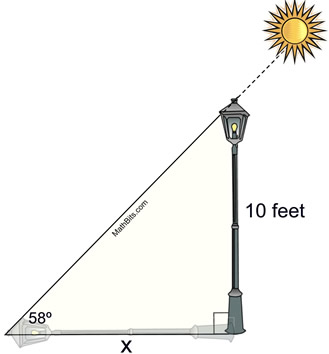
Find the shadow cast by a 10 foot lamp post when the angle of elevation of the sun is 58º. Find the length to the nearest tenth of a foot.
elevex4a
SOLUTION:
• Remember that the "angle of elevation" is from the horizontal ground line upward.
• It is assumed that the lamp post is vertical, making it perpendicular with the ground.
Shadows are on the ground! If you place the "shadow" on the hypotenuse you have created an apparition ( a "ghost"), not a shadow!
• This solution deals with "opposite" and "adjacent" making it a tangent problem.
elevex4m

ex4
Not all trigonometry word problems will use the terms "angle of elevation" or "angle of depression". You may need to read carefully to see where to indicate the angle in the problem.
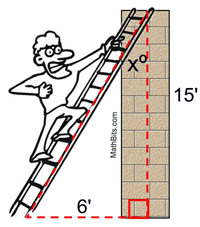
A ladder leans against a brick wall. The foot of the ladder is 6 feet from the wall. The ladder reaches a height of 15 feet on the wall. Find to the nearest degree, the angle the ladder makes with the wall.
eleExample1
SOLUTION:
• In this problem place xº where the ladder meets the wall. Do not assume that the angle will always be at the ground level.
• It is assumed that the wall is vertical, perpendicular with the ground.
• The foot of the ladder is the bottom of the ladder, where it hits the ground.
• This solution deals with "opposite" and "adjacent" making it a tangent problem.
eleExma1

ex5
It may be the case that a problem will be composed of two overlapping right triangles.
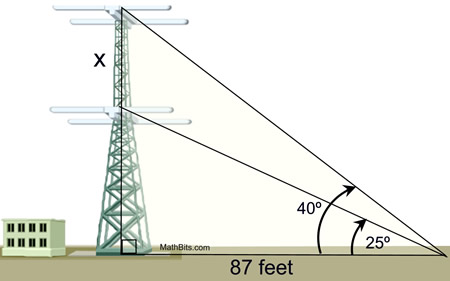
A radio station tower was built in two sections. From a point 87 feet from the base of the tower, the angle of elevation of the top of the first section is 25º, and the angle of elevation of the top of the second section is 40º. To the nearest foot, what is the height of the top section of the tower?
elevex5
SOLUTION:
• Think of this problem as working with two separate triangles:
(1) the larger triangle with the 40º angle and a vertical side that represents the ENTIRE height, b, of the tower, and
(2) the smaller triangle with the 25º angle and a vertical side, a, that represents the height of the first (bottom) section of the tower.
• Solve for the vertical heights (b and a) in the two separate triangles.
• The needed height, x, of the second (top) section of the tower will be the difference between the ENTIRE height, b, and the height of the first (bottom) section, a. You will need to subtract.
• In both triangles, the solution deals with "opposite" and "adjacent" making it a tangent problem.
• Larger triangle with height b: elevB1a
• Smaller triangle with height a: elevB2a

• Difference (b - a): 73.00166791 - 40.56876626 = 32.43290165 ≈ 32 feet